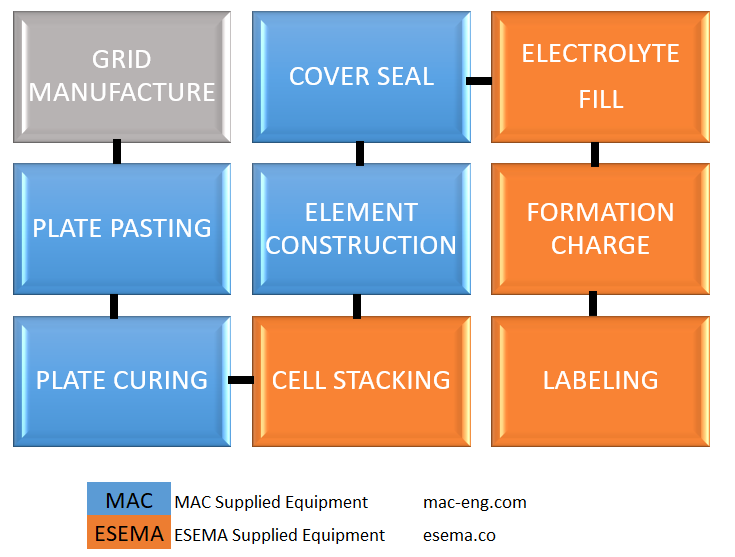





The manufacturing of a lead-acid battery begins with the creation of grids made from a lead alloy, which may include small amounts of other metals to enhance strength and conductivity. These grids serve as both the electrical conductors and the structural framework for the active material. The grids could be cast in a mold or punched from rolled lead strip.
Pasting
A paste mixture is prepared using lead oxide, sulfuric acid, and water. For the negative plates, expander materials—typically powdered sulfates—are added to the paste. This paste is then applied to the grids using a MAC paster, forming what are known as pasted plates. The plates are then flash dried in a MAC Flash Dry Oven. At the end of the pasting line is a MAC High Speed Stacker which neatly stacks the plates.
Curing
The pasted plates undergo a curing process in a controlled environment with elevated temperatures and regulated humidity. Over a period of two to four days, crystalline structures form, binding the paste securely to the grids. After curing, plates must be fully cooled and dried. MAC offers Curing Chambers to the Americas market that speeds up this process.
Element Assembly
Once ready, plates are alternately stacked with separators, which are porous sheets designed to prevent internal short circuits while allowing ion flow. All positive plates are connected together, and separately, all negative plates are connected, forming a single element using a MAC Cast On Strap (COS) These 2 volt elements are inserted with a MAC Case Inserter into a battery case, aligned, and welded in series with a MAC Tiegel TTP Welder to achieve the desired output voltage (e.g., 6V, 12V).
Sealing & Terminal Formation
A cover is then sealed onto the case with a MAC Heat Sealer, creating an acid-tight seal around the terminal posts, which protrude from the top of the battery for external connection. The terminal post are bonded using a MAC Post Bonder or MAC Flameless Induction Bonder (IHTP). Quality seal checks are made using the MAC Leak Tester.

Electrolyte Filling & Formation Charging
The assembled battery is filled with sulfuric acid (electrolyte) and undergoes a formation charge—a process in which the battery is electrically charged for several hours. This step activates the chemical reaction necessary for the battery to store and deliver energy.
Final Steps: Quality Control & Labeling
After formation, the battery undergoes rigorous quality inspections, is cleaned, and receives its final labeling before being shipped to its point of sale.